
Monobars, just a hype or are the aerodynamic benefits real?
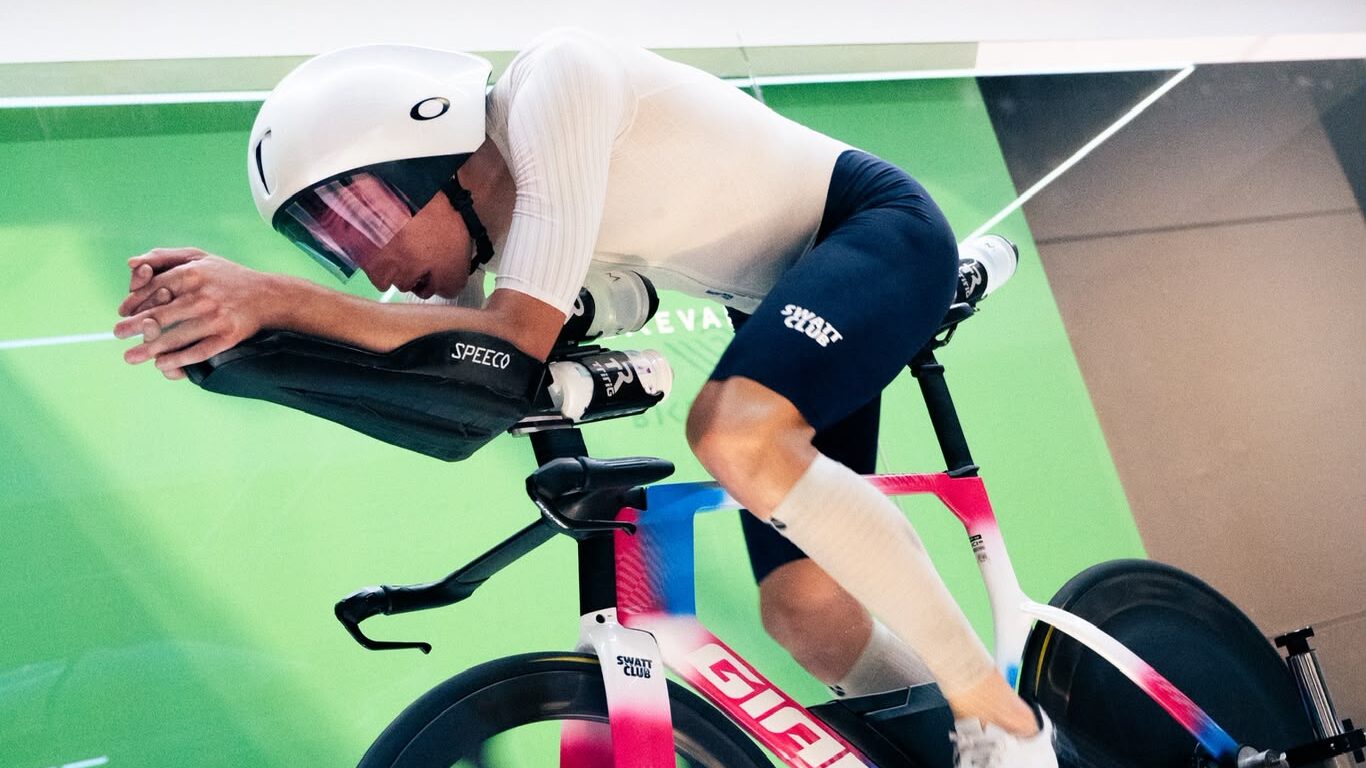
If you follow new tech developments in triathlon like we do, you will have spotted more athletes riding with what we like to call ‘monocoque extensions’ on their bike setup. Beyond scattered individual claims of aerodynamic improvements after switching from ‘traditional’ dual extensions to monocoque counterparts, no publicly available research exists on which is actually faster. We at Speeco do not follow unfounded trends. Instead, we aim to always create the fastest cockpit possible for our athletes. When the time came for our design engineer, Zeb, to tackle his thesis, we saw a chance and set about doing the research ourselves. In the span of 5 months CFD simulations utilizing a tailored version of the AiRo.app software were combined with a Wind tunnel test at the Belgian Cycling Factory Bikevalley with Ironman 70.3 Aix-en-Provence winner Michele Bortolamedi.
Method
Positions
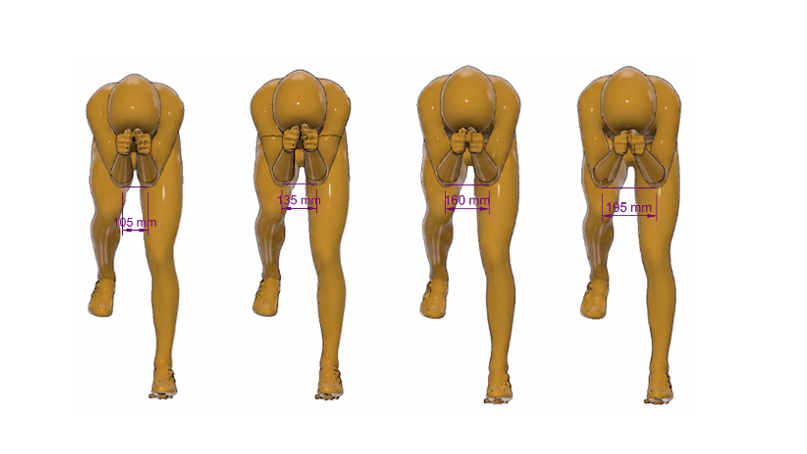
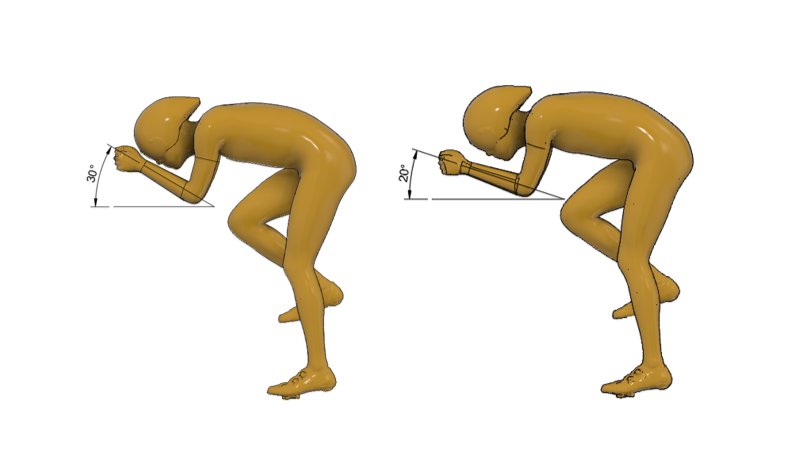
To ensure we create useful data for all of our athlethes and costumers, we covered a whole spectrum of riding positions. Following an analysis of our database of previously created TriX setups (available with a 20% discount in the showcase), we distinguished four different elbow widths ranging from Super-Narrow (105mm) to Wide (195mm) with Narrow (135mm) and Neutral (160mm) inbetween. We tested each width with two arm positions defined by forearm angles of 30 degrees (high) and 20 degrees (low). The 3D models of the cyclist in these positions are created using the generic cyclist model. For the windtunnel testing, Bortolamedi’s postion can be adjusted from SuperNarrow to Neutral, and from 20 to 30 degrees arm angle.
Aerobar shapes
As a benchmark, our previously CFD- and wind-tunnel-optimized custom dual TriX extensions are used. For it’s closed-center counterpart, more than 20 iterations were developed and evaluated in Airo, progressively varying hull shape, depth, and edge radii to arrive at an optimized monocoque aerobar. The benchmark and each iteration was tested in the 8 different riding positions. To enable efficient wind-tunnel testing, modular extensions were created that could be quickly converted from a dual to a monocoque configuration and test different center-shapes. To ensure consistency between CFD and wind-tunnel testing, the CFD simulations were also re-ran using the 3D model of these identical modular extensions.
Individual aerobar iteration results are kept confidential for our competitive advantage.
Tested aerobar shapesYaw angles
Aside from track cycling, wind is never 100% straight on the rider. The angle of attack of the wind is called the yaw angle. Previous research for the optimization of our dual TTX and TriX bars showed that aerobars can be subject to the sailing effect, making different aerobars either slower or faster under different yaw angles. Track testing is thus unsuited to quantify differences in aerobars.
Since athletes and events differ in speed and wind conditions. A model to evaluate the importance of various yaw angles with ‘yaw weights’, fractions of time spent at each yaw angle. The essence of these yaw weights is to generate a single CdA value from tests conducted at multiple yaw angles, allowing us to compare the different types of extensions with the real-world impact of yaw factored in.
Unfortunately, the used CFD simulation software did not feature yaw angles yet, so CFD simulations were primarily used to gain initial insights. Previous windtunnel testing showed that monocoque extensions function best at low-yaw angles. Because of this, the best achieving monocoque aerobar at 0 yaw could then be compared to the benchmark over 0°, 5° and 10°. 15° can be relevant for age-grouper athletes, but was left out for time efficiency.
Finally, a difference in testing velocity should be noted: CFD limited us to a testing velocity of 40km/h, whereas wind tunnel tests were done at the most representable velocity of 45km/h.
Results
CFD
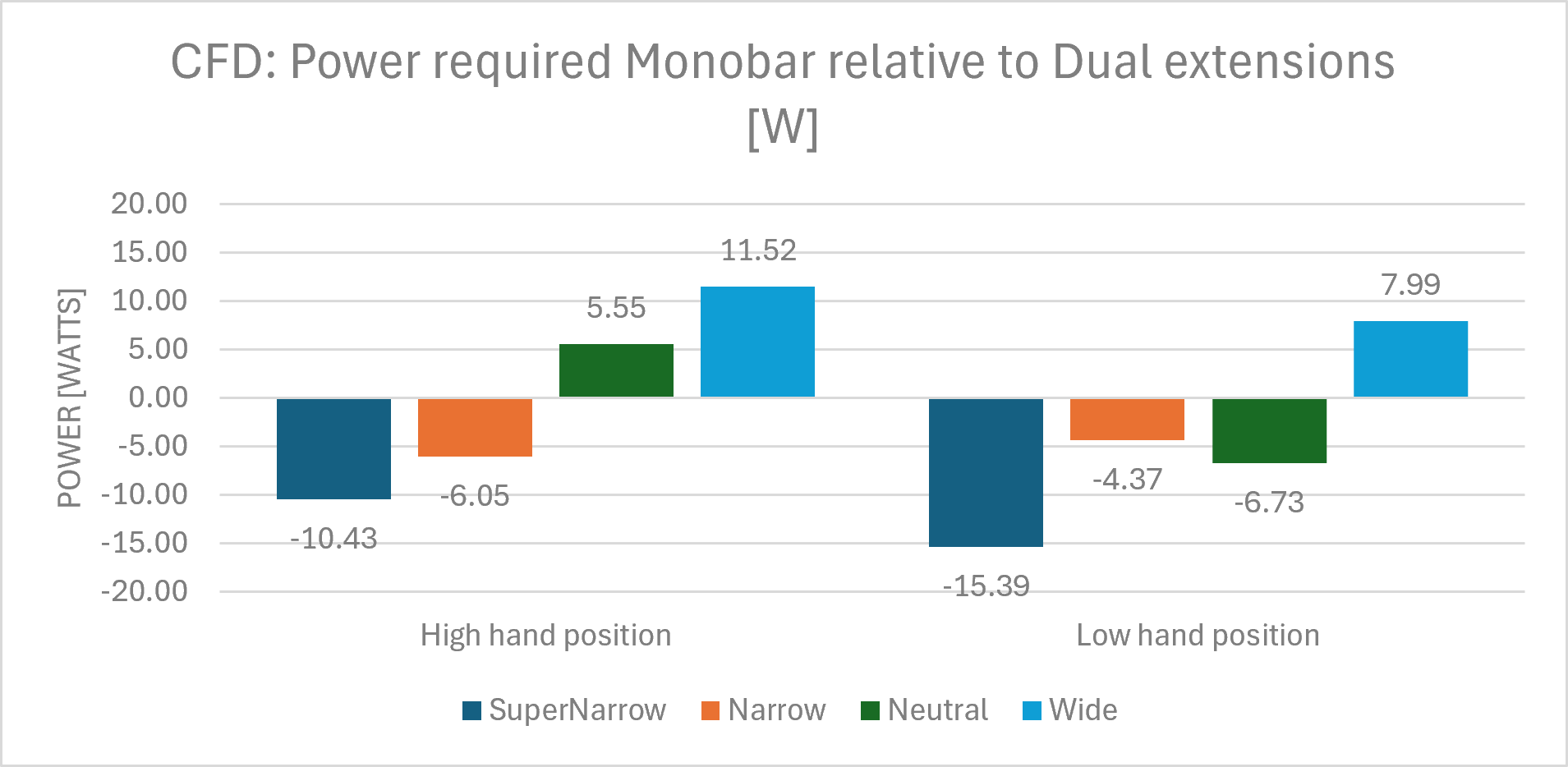
The difference in required power (Watts) of a monobar relative to dual extensions across 8 positions under 0 Yaw.
At negative, the monobar is faster.
Wind tunnel
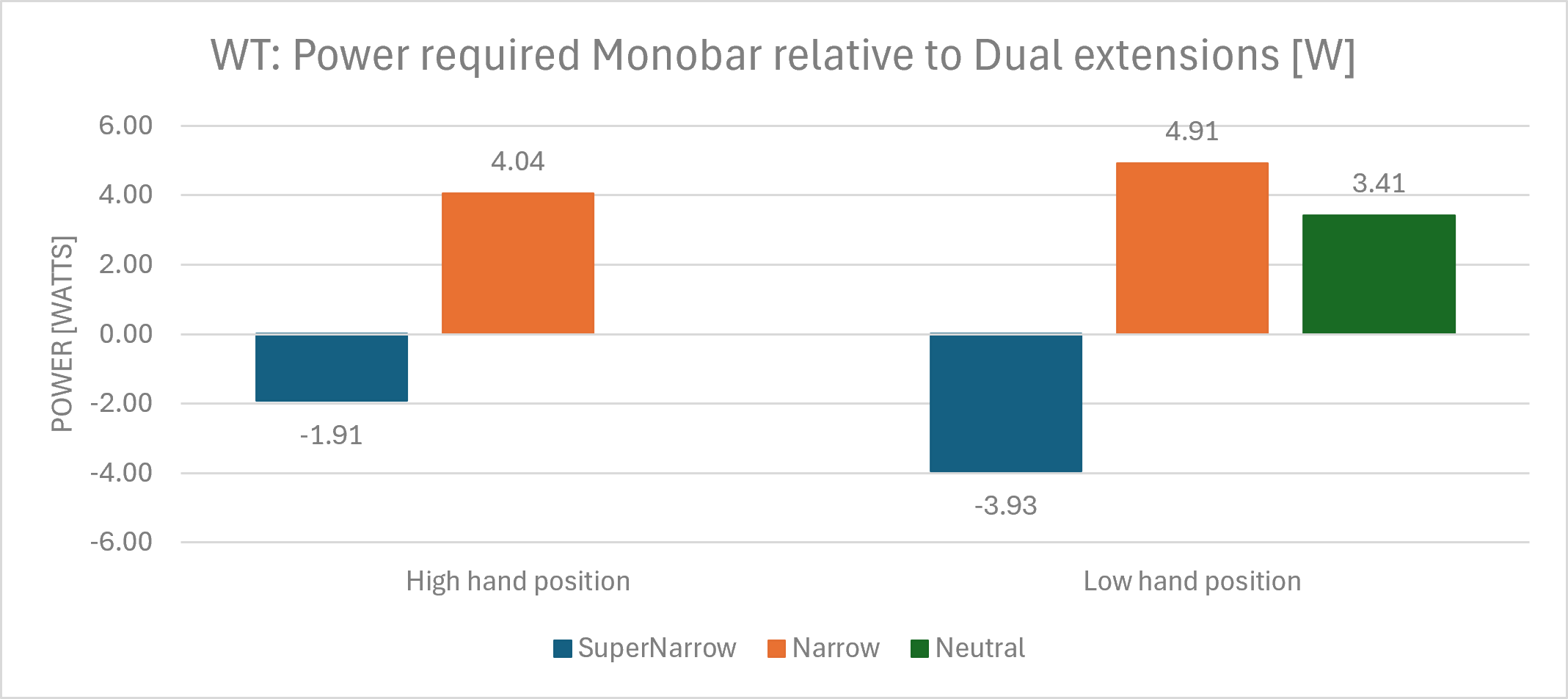
Comparison of the optimized monobar and dual aerobar. Tested under 3 yaw angles and calculated under their respective yaw weighting for Michele. Together with the Italian ‘Falco’, Michele Bortolamedi, only positions most relevant for him were tested, as limited wind tunnel time prevented us from replicating every position simulated.
At negative, the monobar is faster.
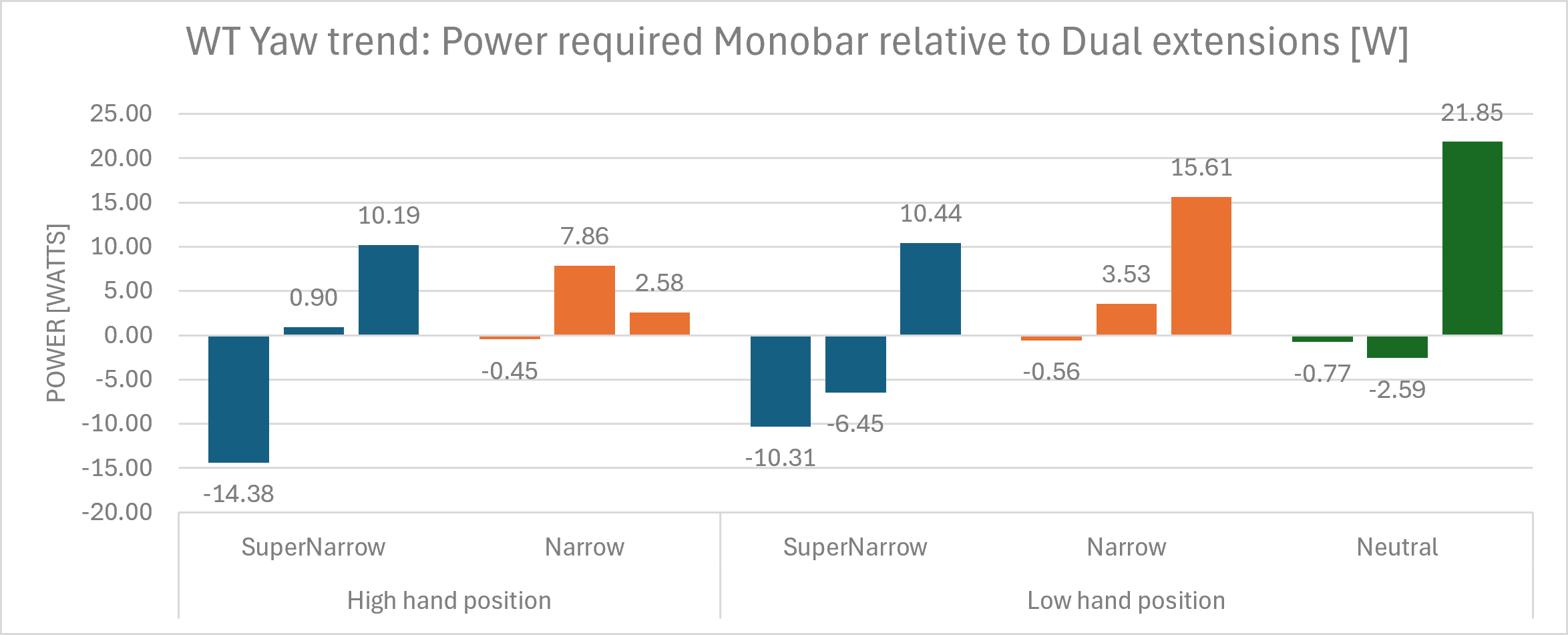
Comparison of aerobar performance at each yaw angle (0°, 5° and 10°)
At negative, the monobar is faster.
Discussion, conclusion
CFD
Shows that narrow mono extension setups experience a reduction in aerodynamic drag compared to dual extensions. Conversely, wider mono-extension setups increase drag relative to dual extensions. The simulations reveal a clear connection between elbow-widths and the fastest extension design. Both for a low and high hand position there is a transition from mono to dual extensions the wider the elbows are placed. Based on this: “Elbows close together? Go mono. Spaced out? Choose dual extensions.”
Windtunnel
The windtunnel testing provides conflicting results, as aerobar performance shifts significantly over different yaw angles. Although monobars perform well at 0° yaw angles, they are consistantly outperformed by dual extensions under high yaw angles, essentially proving that dual extensions benefit more from the sailing effect than mono extensions. A better slogan will be “Elbows completely together? Go mono. Spaced out? Choose dual extensions. In between? It depends..”
Adjusting our yaw weight model to Bortolamedi’s racing situation, only a SuperNarrow position would be more aerodynamic if they were to be mono-extensions. As this position is for now only sustainable in the “Narrow” setting, dual extensions remained the optimal choice when creating his custom TriX extensions.
Implementation
As both the CFD Simulations and Wind tunnel show, there is no ‘one extension concept fits all’ solution. Changes in position and yaw angles can lead to a change in concept choice. Following Zeb’s successful Bachelor’s thesis defense, we have started refining our yaw weight model to integrate into our custom extension design process. By simply sharing us your expected riding speed and planned racing venues when you place an order, we can tailor your extensions precisely to your unique riding profile. bringing us one step closer to our mission of making custom the new standard.
Due to the extensive “it depends” nature of these results, further testing will (have to) be caried out with multiple athletes to increase the data on which the mono vs. dual extension choices are made, including the addition of a 15 degree yaw angle to complete the sweep. More race data also has to be analysed to further improve the weighting. This page will therefor be updated.